I was on vacation in Sicily for the first time this summer to visit Eugenio’s hometown in Comiso, located in Southern Sicily. Little did I know that a good 1.5- to 2-hour drive away lies a magnificent and massive collection of probably the biggest and most well-preserved Greek temples there are outside Athens. One fine evening, they brought me to see the famous temples.
The Valley of the Temples (Italian: Valle dei Templi) in Agrigento, Sicily boasts of an impressive number of archeological sites from the ruins of the ancient Greek city of Akragas. I’ve read that Akragas is actually one of the the main cities of what the Romans call the Magna Graecia (Greater Greece), which refers to the coastal areas of Southern Italy that were, in fact, heavily populated by the Greek settlers. A quick look in Wikipedia will say that there is an estimated 200,000 to 800,000 people living in this city around 406 BC! That’s quite a lot indeed! Well, that’s not hard to believe because this area is vast. And I mean, VAAAAAAAST! They say it’s probably the biggest archeological site in the world.
When you arrive there at the entrance where there is the parking lot, you’re not really ‘in there’ yet. The parking lot is a few kilometers downhill the farthest temple. You cannot take your car up there so you have to take the taxis from the parking lot towards the topmost temple, which will cost you 3€ per person. Click here to see the complete entrance rates which change with the season. Okay, now, here are what I saw!
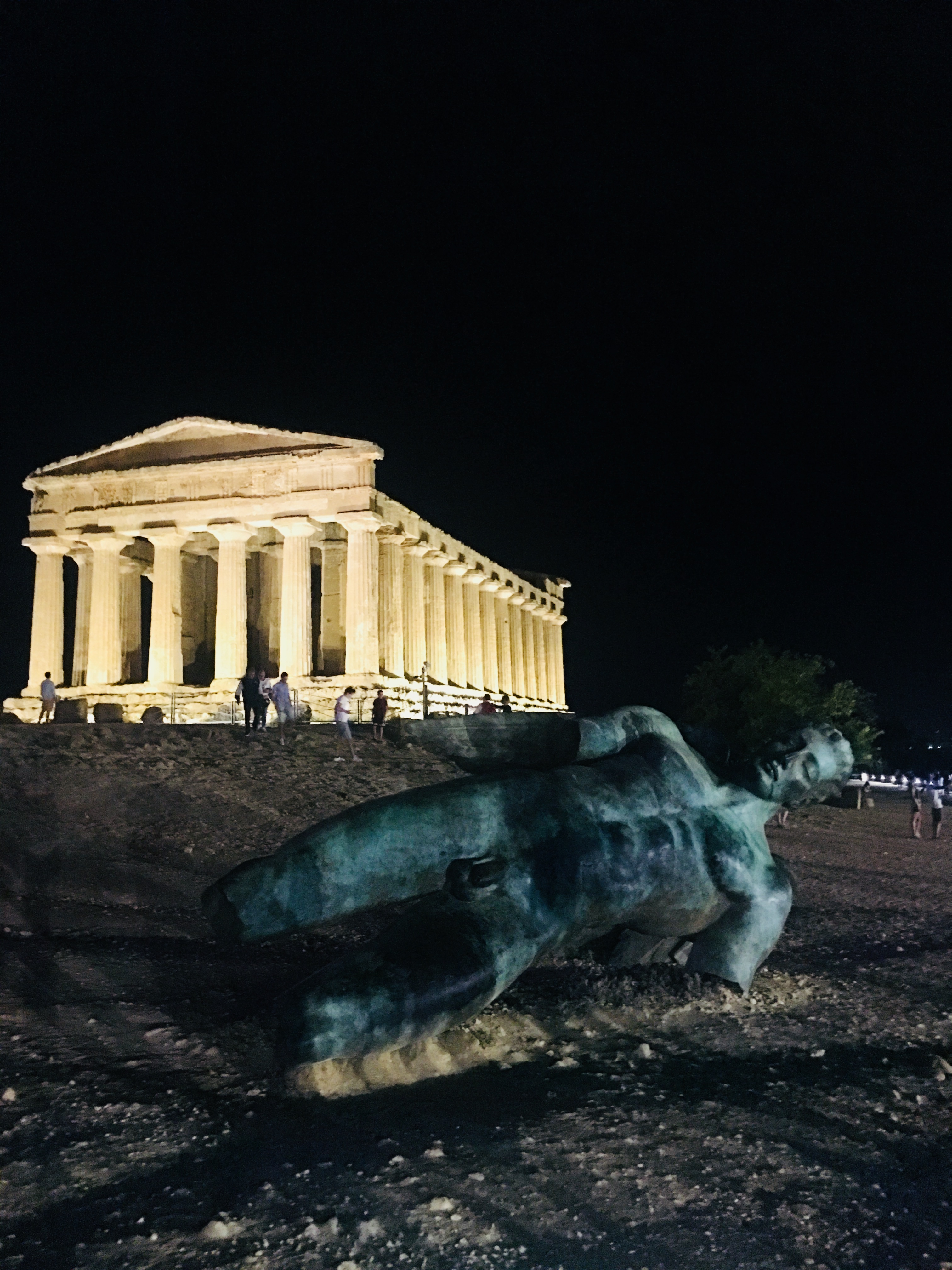
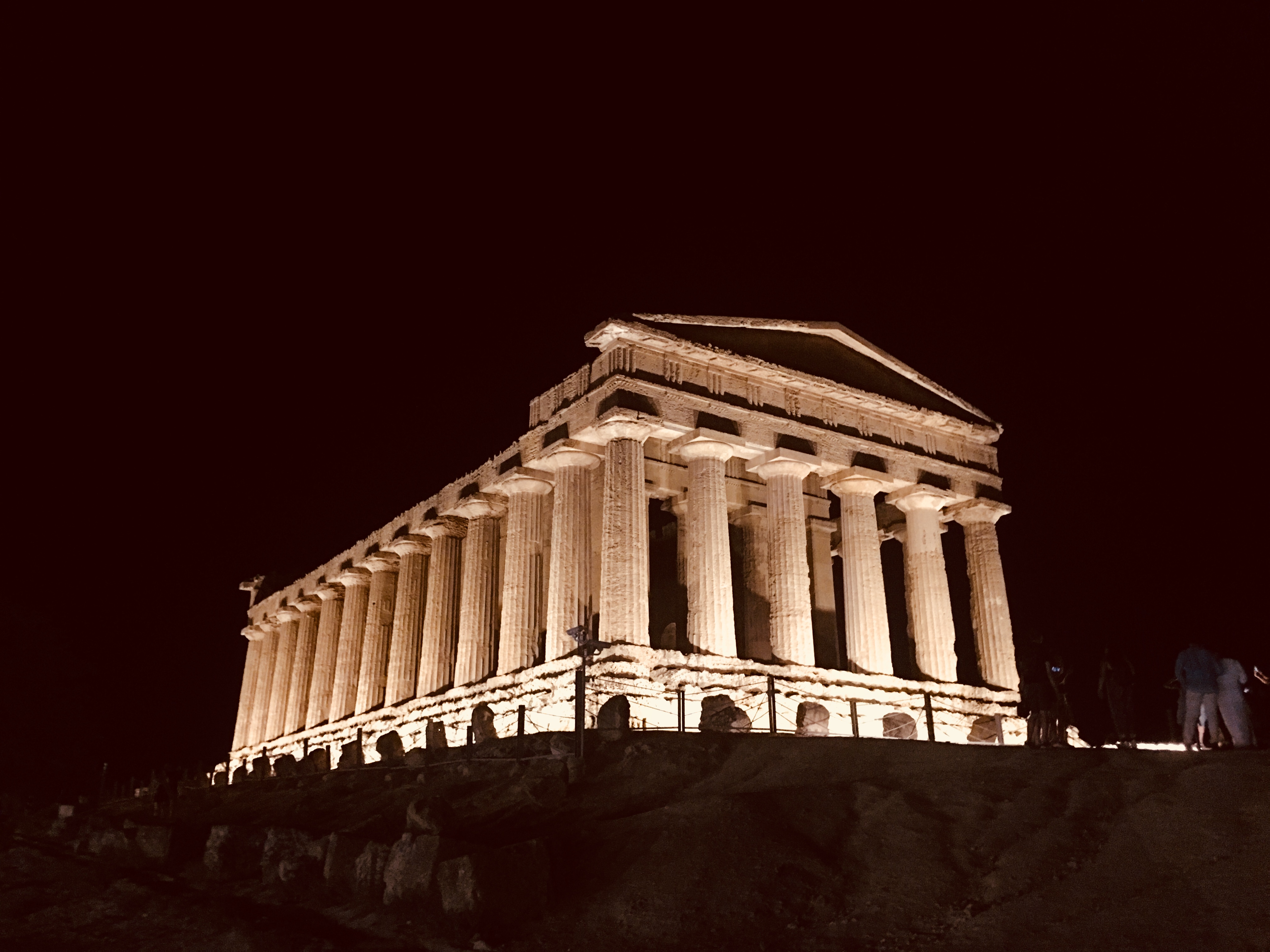
Temple of Concordia
It is the largest and most well- preserved Greek Doric temple in Sicily and they say that it is one of the best preserved temples of its kind. ‘Doric’ actually refers to the Doric order which is the first style of classical
Statue of IcarusTemple of Concordia
architecture, pertaining mainly to the sophisticated styles of ancient Rome and Greece. I read that it dates back to around 430 BC! It survived a lot of things, including all the bombings of the wars (I’m not sure but I think it was agreed not to bomb them because of the archeological sites), and is very much intact up to this day.
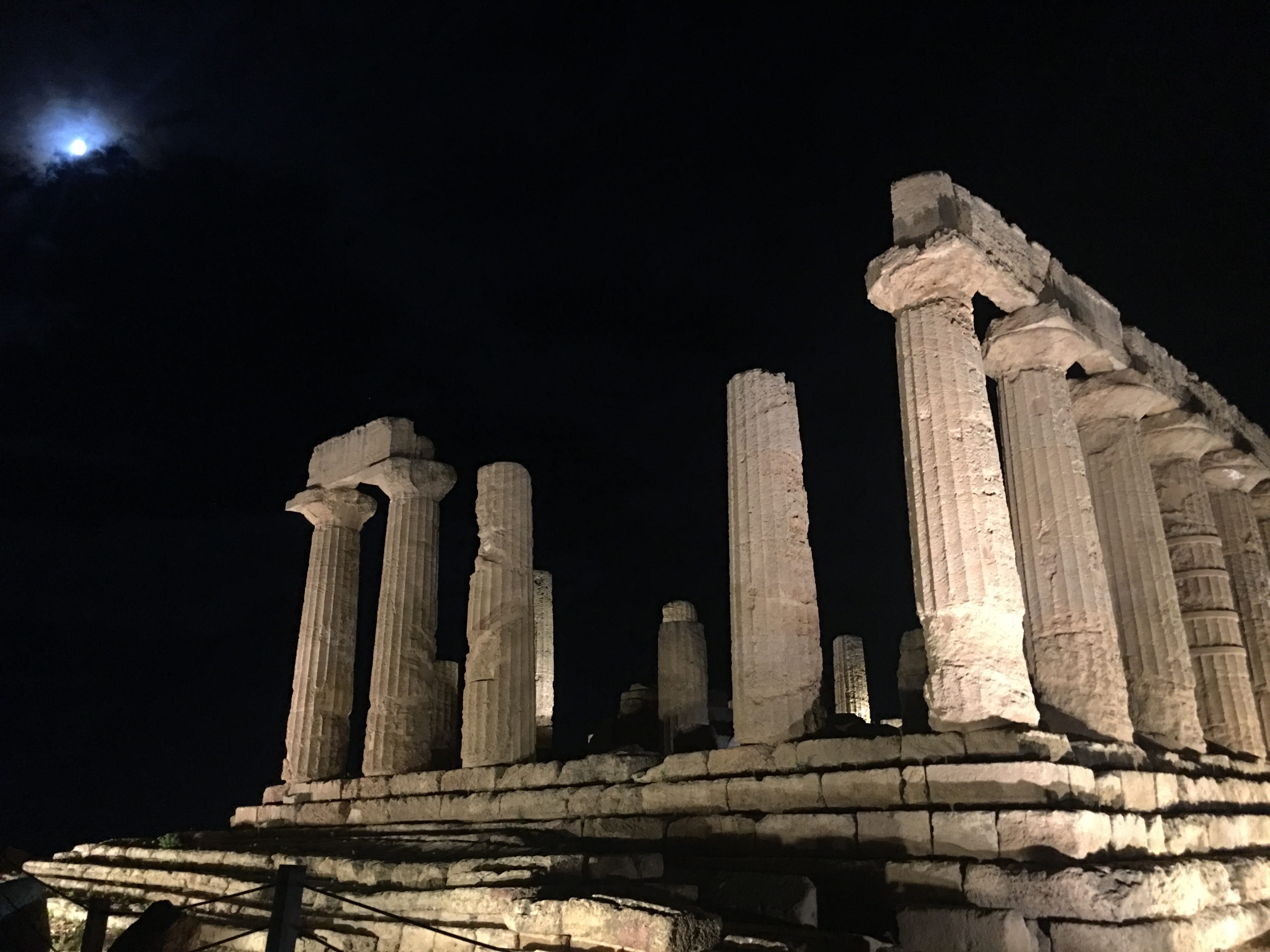
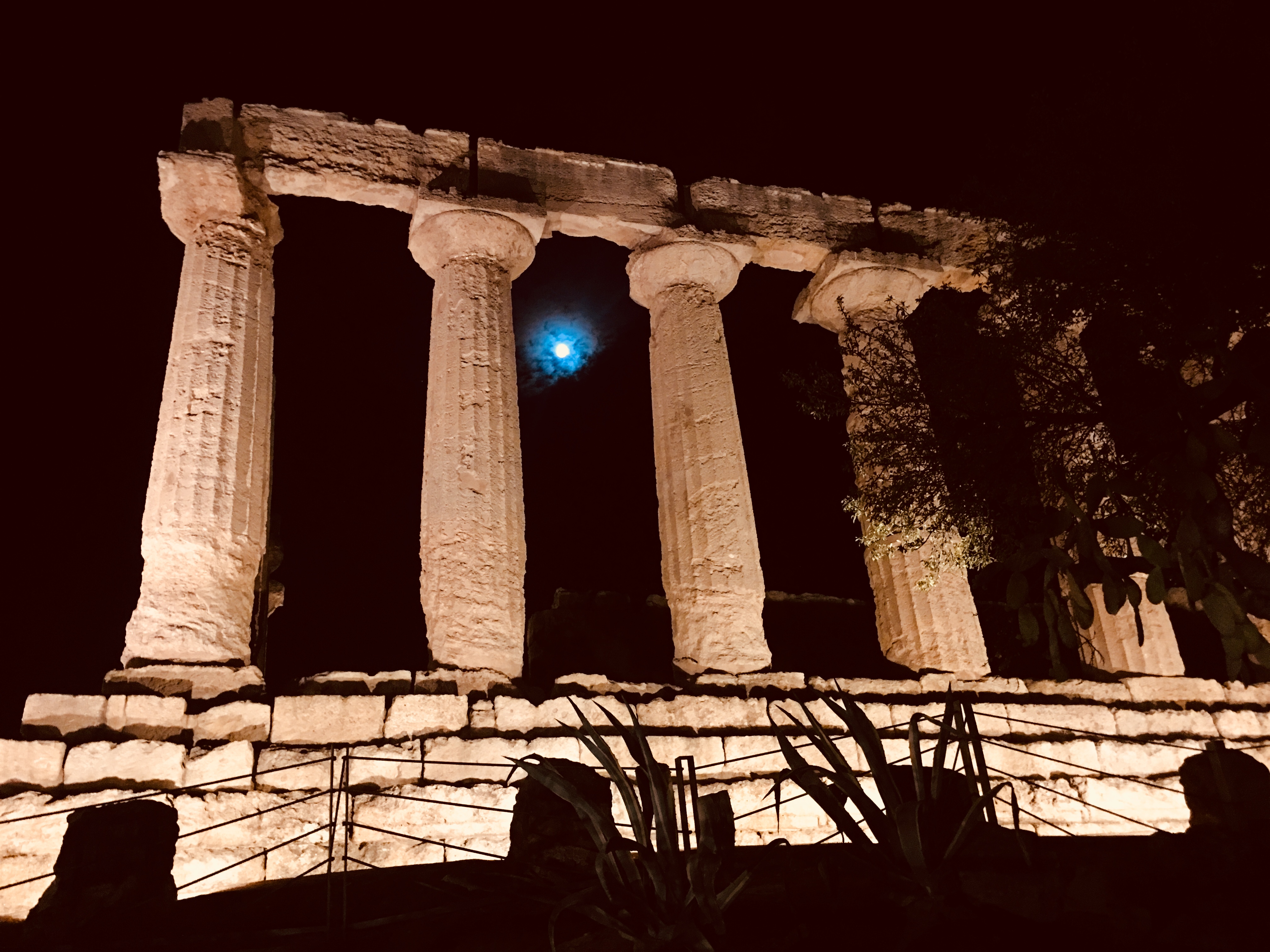
Temple of Juno (Hera Lacinia)
This temple used to look like the Concordia but was ruined by a fire wayback in the 400++ BC.
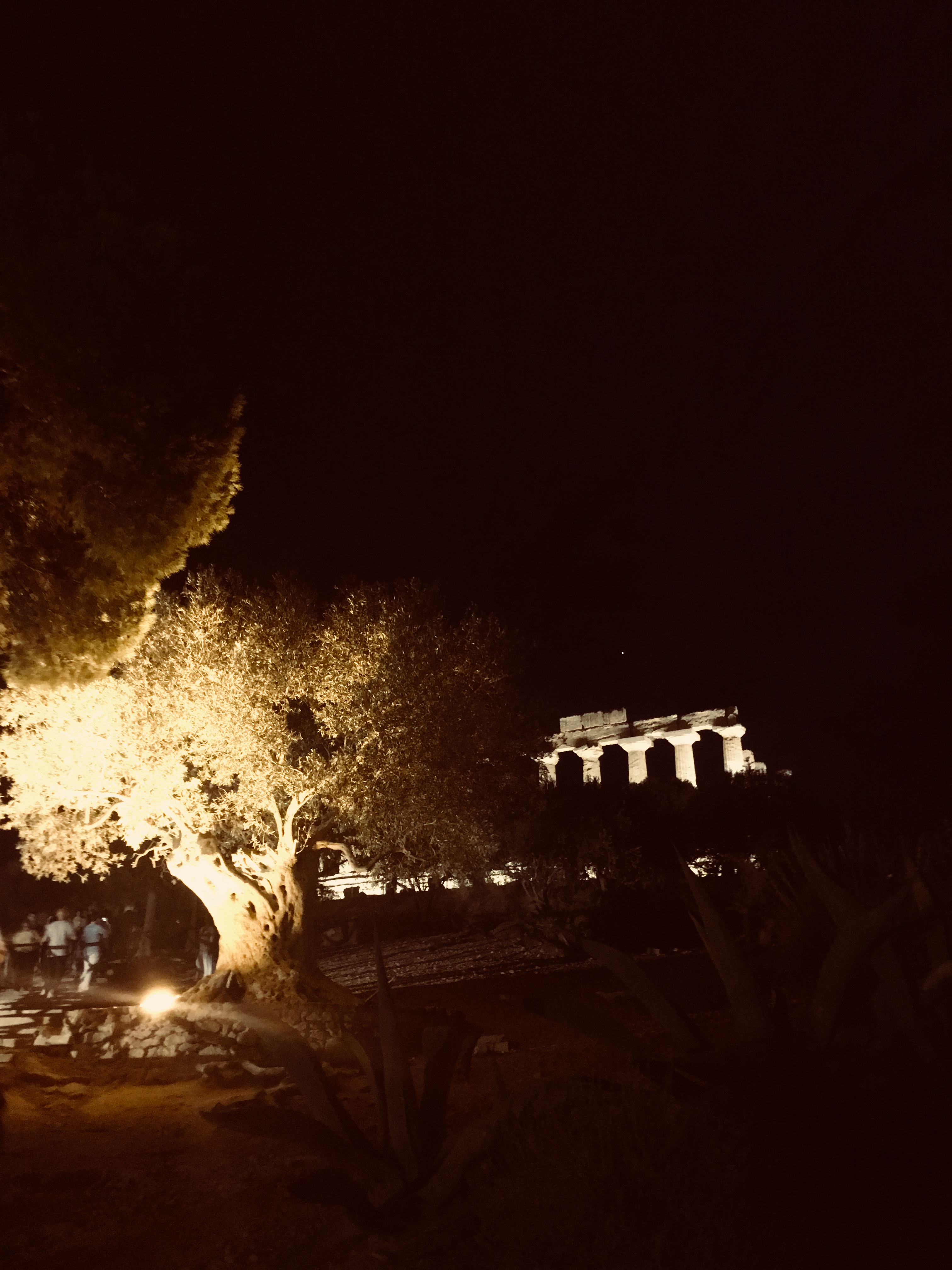
Temple of Hera photobombed by the moonTemple of Hera
A 1000+-year-old olive tree
Amazing isn’t it? That is how a much wiser olive tree looks like. 🙂 Oh the things that it has witnessed, aplenty!
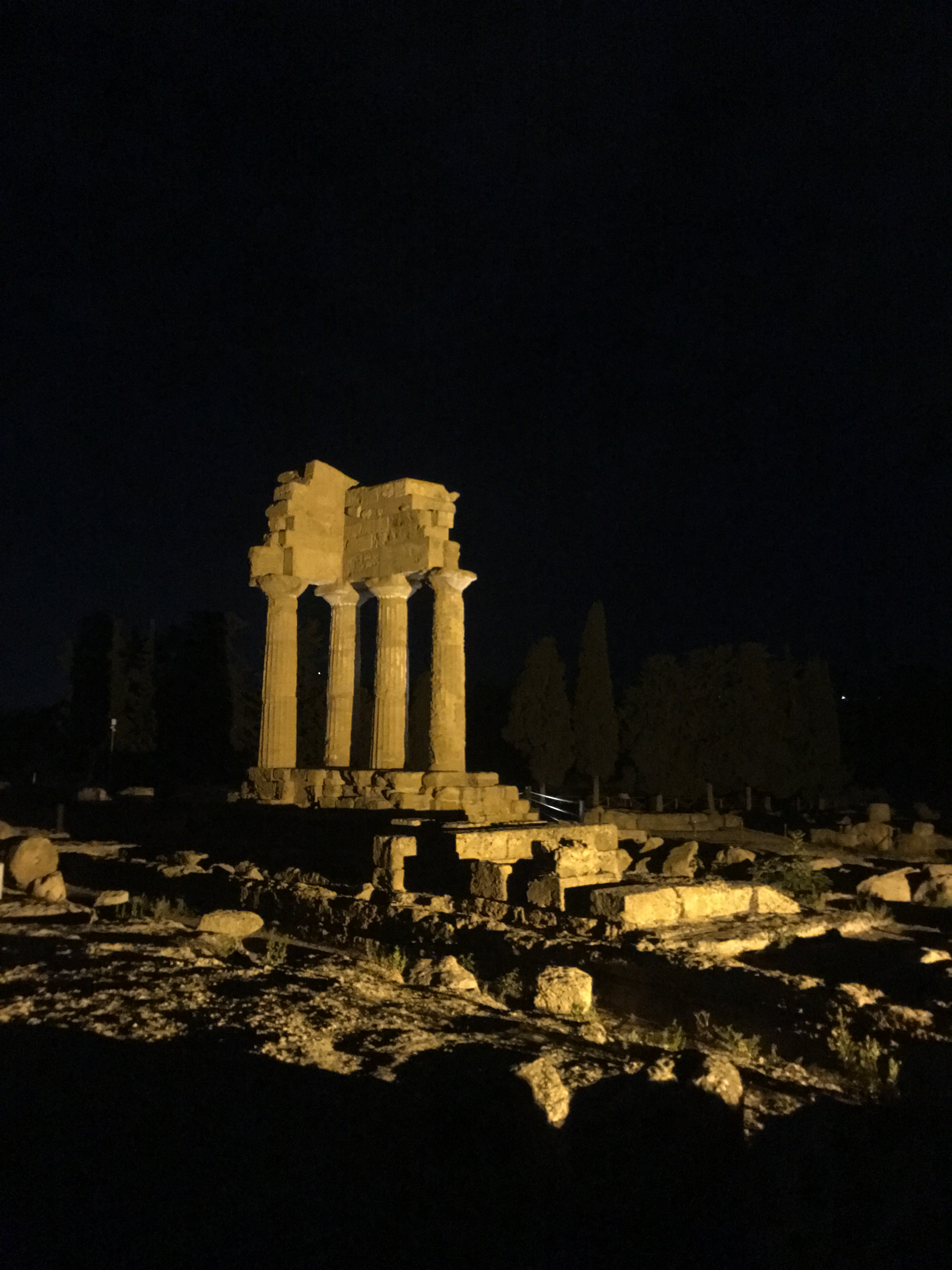
Temple of Castor and Pollux
One of the most famed temples in the area, named after the mythological twins Castor and Pollux. It is actually the symbol of Agrigento.
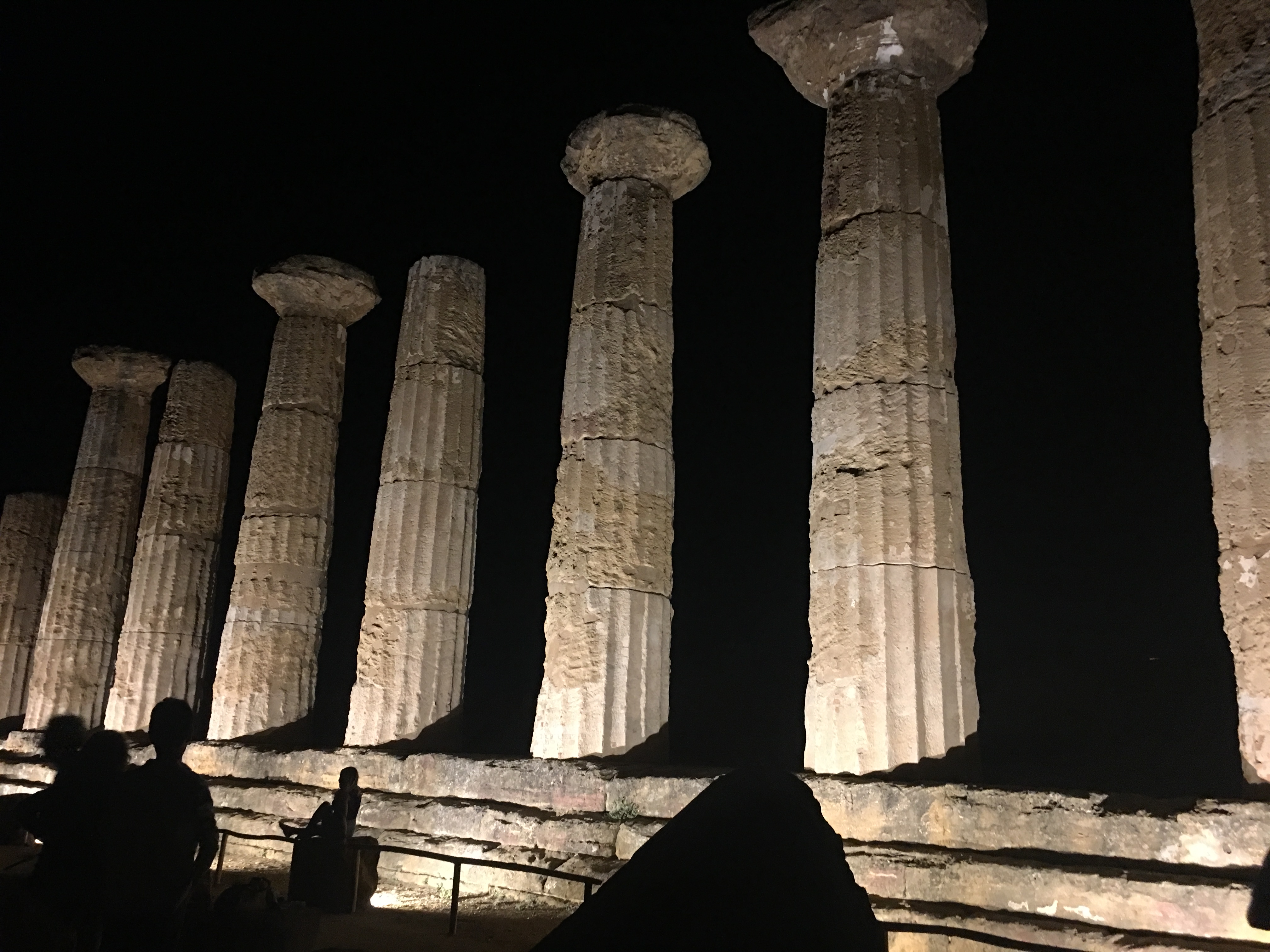
Temple of Hercules
This is the oldest temple in this site, and only a few columns of it remain. I’ve read that it may have been there since 480 BC!
Temple of Hercules
It really overwhelmed me when I saw the temples on a beautiful moonlit night. Walking under the moonlight, admiring not just one, but, one Greek temple after another in well-lit paths lined with trees (they say almond) and stones, and knowing that you’re treading the same paths that ancient people (who lived before Christ!!!) have also walked on, is such a humbling experience. It makes you realize that you are but one tiny speck in one tiny piece of time in the universe.
The province of Batanes is a group of islands located in the northernmost fringes of the Philippines. It is so north that it is actually closer to Taiwan than to the main Philippine island of Luzon. People would always hear it mentioned when a typhoon is referenced to it because of the doppler radar in the area, which somehow brands the province as a typhoon-prone island, but the locals told me that they are rarely hit by typhoons.
Every Filipino will have Batanes on their travel bucket list because of the serenity it offers, however, the flights going there can be a bit more expensive. Because of my friend’s persistence, we were lucky enough to get one of our tickets at half the price. We also went at a non-peak season, in August 2016. I have already forgotten the total amount we paid for the roundtrip flight, but I think it was somewhere around Php 9,000 each. Batanes is served by two airlines, Philippine Airlines and Skyjet, with one trip from Manila to and from the island each day.
Since our trip was mainly for de-stressing, we joined a small tour group for 3 days for about Php 5,000 each. Our guide picked us up from the airport in the morning and brought us to the century-old house that we rented for a few days. The mobile signal in Batanes is pretty bad. I was using Globe mobile, and I was only getting 2G. We didn’t have wifi at our accommodation, so it was a really good opportunity to disconnect from the very chaotic city life.
Batanes has 3 main islands: Batan, Sabtang and Itbayat. The capital, Basco, is in Batan, while Sabtang is a short boat ride from Batan. Itbayat, however, is a bit farther. We were able to explore both Batan and Sabtang.
Batan Island
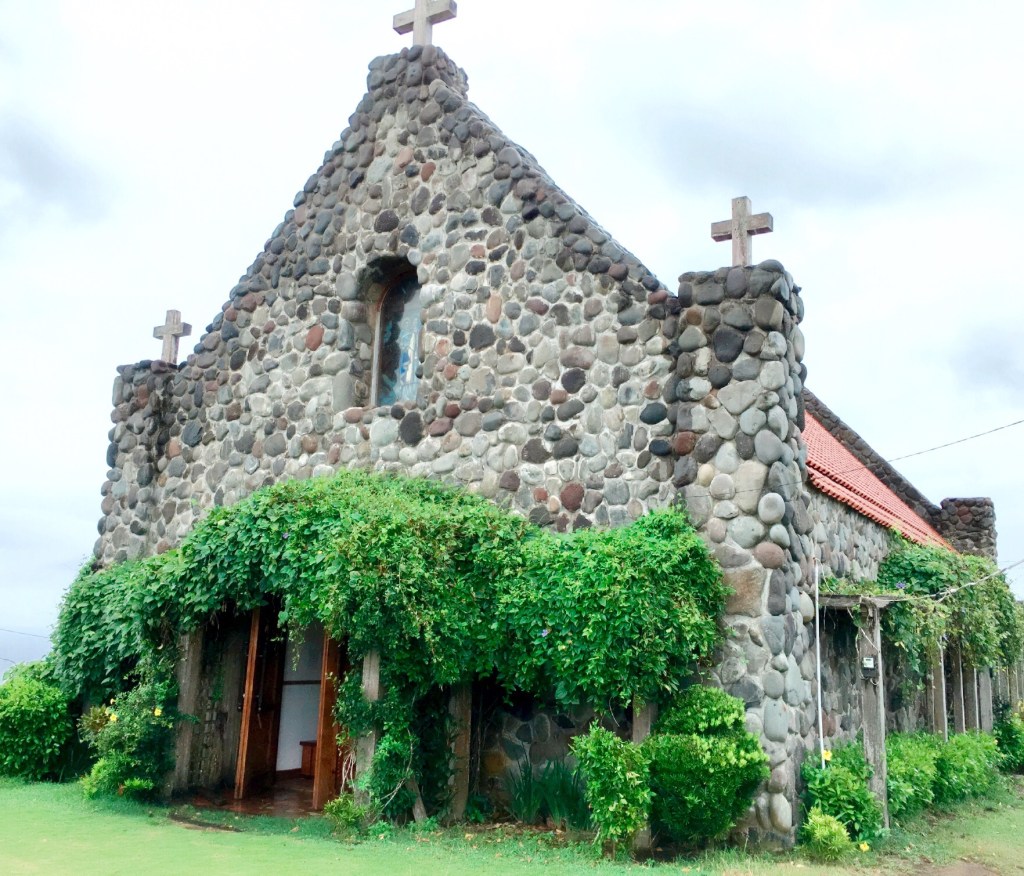
Our first stop is the pretty and picture-perfect Mt. Carmel Chapel which sits atop Tukon Hill. It is probably the most photographed church in Batanes because it really is very charming.
Mt. Carmel Chapel
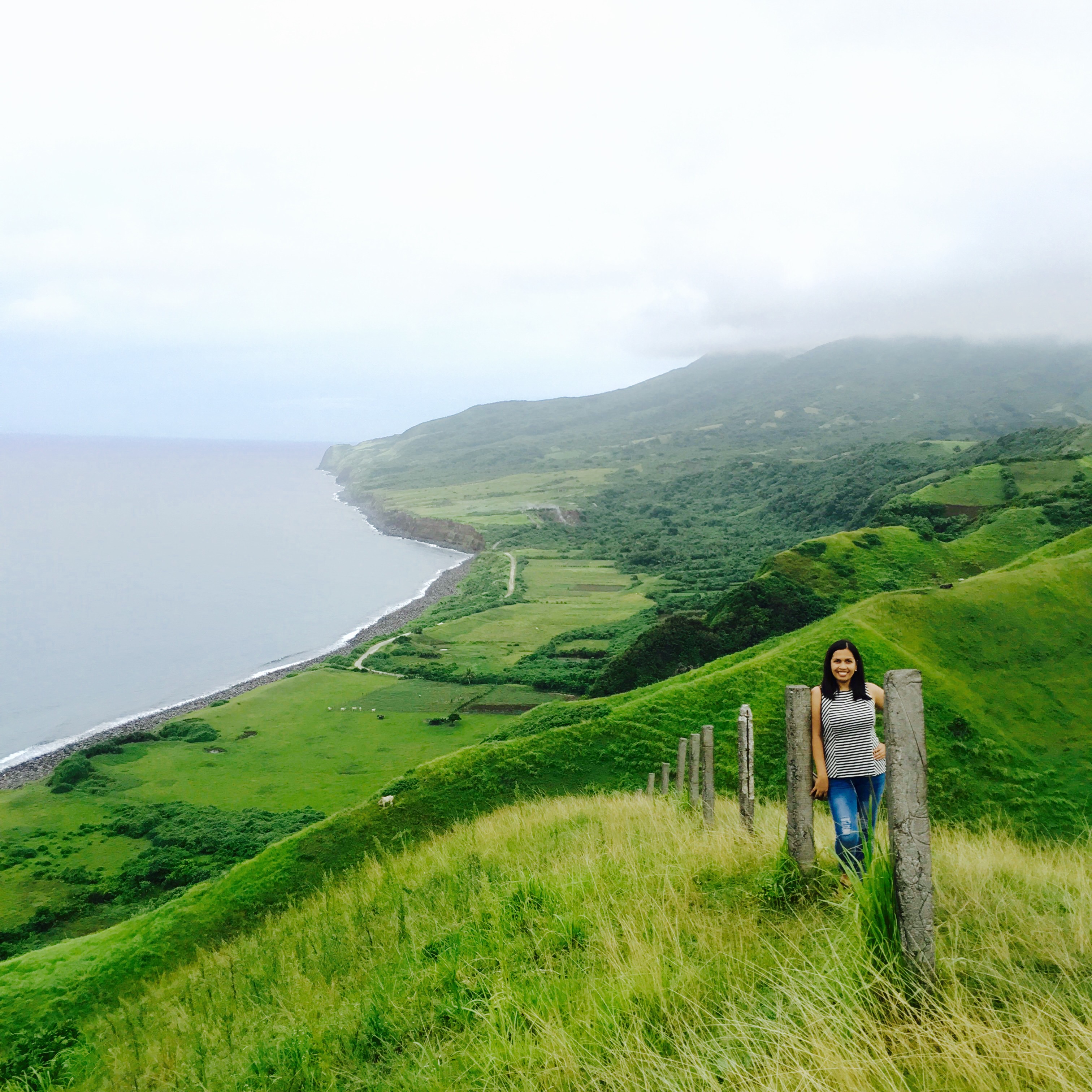
We had our first glimpse of Batanes’ beautiful landscapes at Vayang Rolling Hills. You will need to go on a bit of a hike (it’s an easy one, don’t worry!) to be able to see the stunning view. It was like an endless continuous wave of pretty green hills that is facing the West Philippine Sea. There were no other people in the place when we went there and it was just so peaceful.
Vayang Rolling Hills
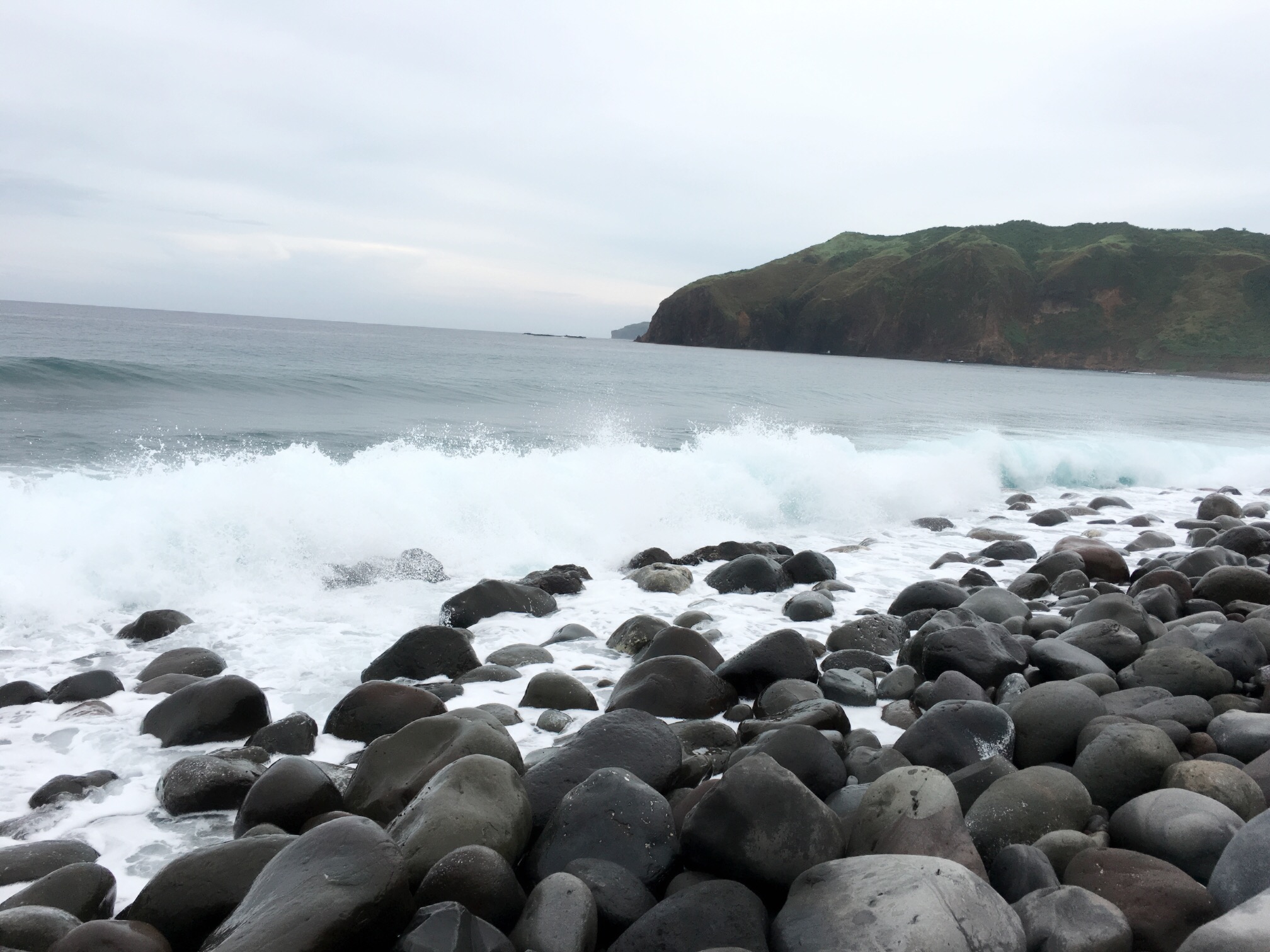
In Batan Island, you won’t see white sand beaches but you’ll see boulder beaches like this one in Valugan. It faces the Pacific Ocean and the waves aren’t so gentle. The shore is full of boulders which came from the eruption of Mt. Iraya hundreds of years ago. It is quite tricky to go down the shore as slipping and tripping could get you to serious trouble. Those are seriously huge and hard boulders down there and not everything you put your feet on is stable, so be very careful. But the sight and the sound of the water splashing on the rocks is really something very pleasing and not to be missed.
Valugan Boulder Beach
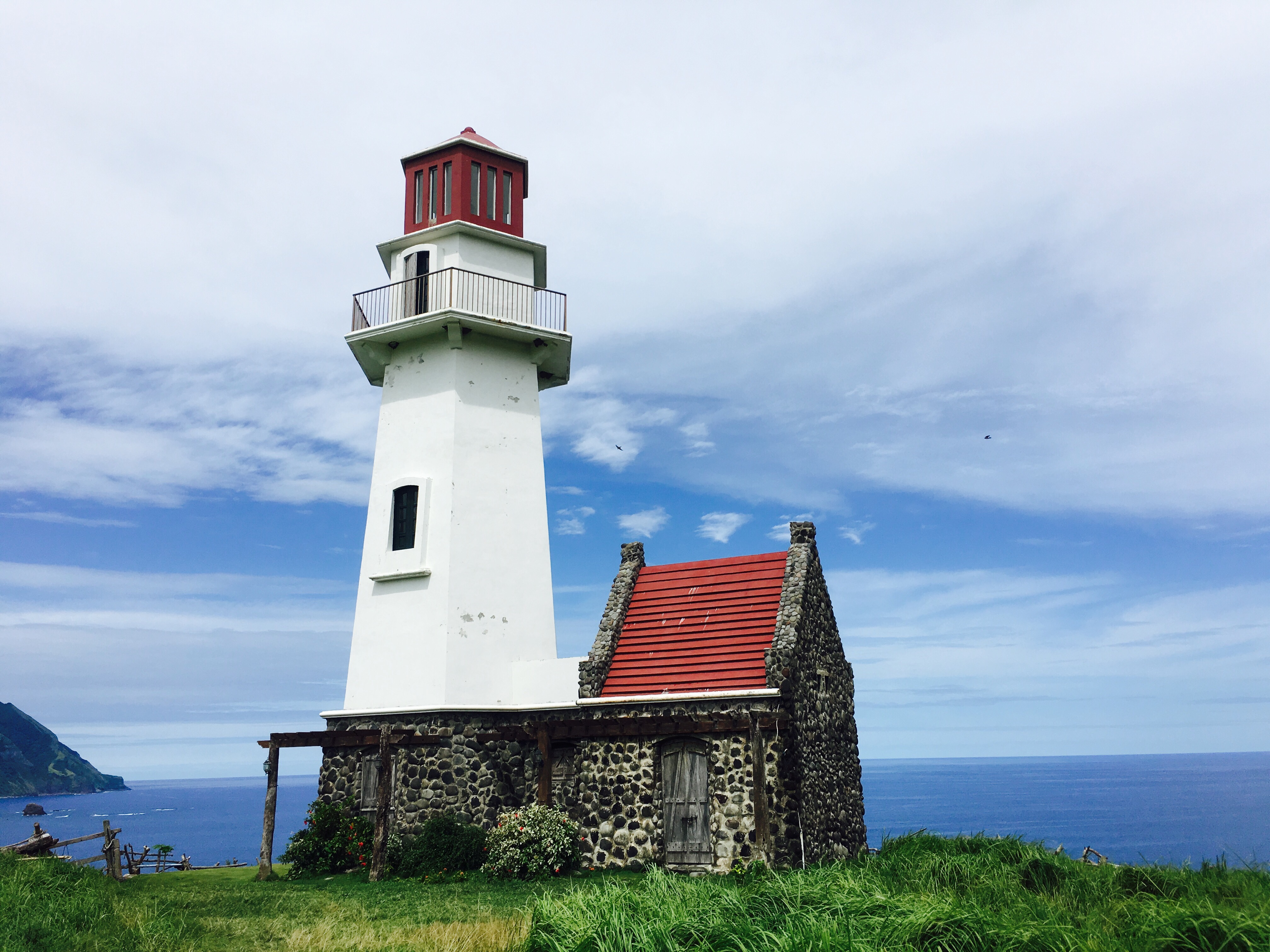
Among the things that make Batanes very picturesque are the pretty lighthouses scattered around it. People would love climbing them all the way up and bask in the amazing views and fresh air. It is also a popular choice for pre-nup shoots.
Basco Lighthouse
Racuh a Payaman
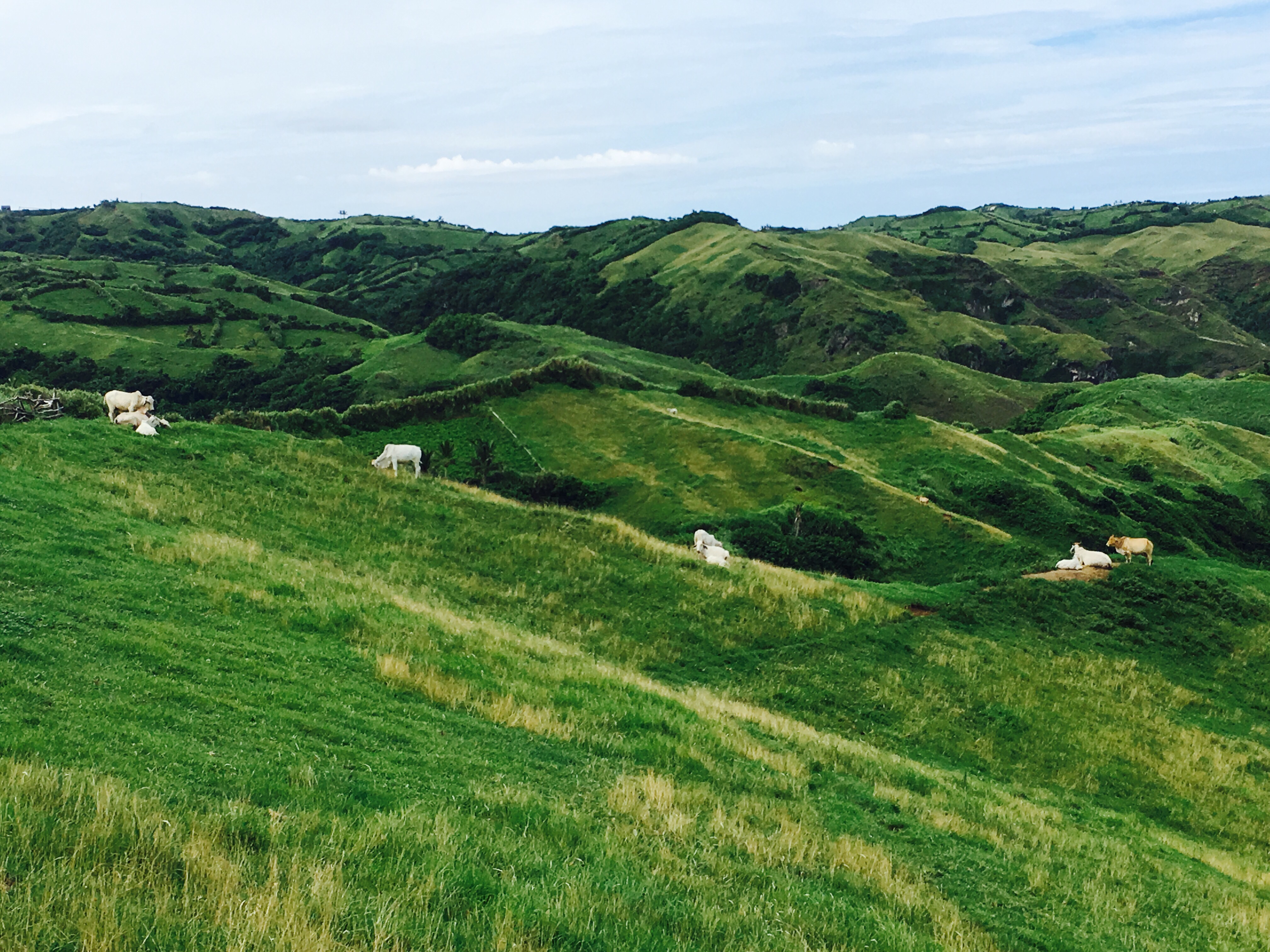
This has always been the highlight of every trip Batanes, a visit to Racuh a Payaman, or more popularly known to tourists as Marlboro Country. I will not describe it to you anymore but will rather let the photos speak for themselves.
Racuh A Payaman (Marlboro Country)
Western side of Racuh a Payaman (Marlboro Country). The Tayid lighthouse is visible from here.
Tayid Lighthouse
Cows peacefully grazing at the protected hills of Racuh A Payaman
Right at the back of the Tayid lighthouse is this beautiful view
Sabtang Island
Sabtang Island is a 30-min boat ride from Batan. The boats here, locally called faluwa, do not have the usual outriggers (Filipino “katig”) because the strong waves and currents at the sea tend to destroy them, so the locals just removed them. These are just small motorized boats, which just seem to dance along with the waves, and it can surely be one hell of a ride, so come prepared. It’s amazing, though, how the boat pilot is very at ease and calm despite all the wave action happening out there in the sea. Surely, there are things that only years of experience can teach you. And these boats, they can carry motorcycles! 🙂
Faluwa: the boat to Sabtang Island
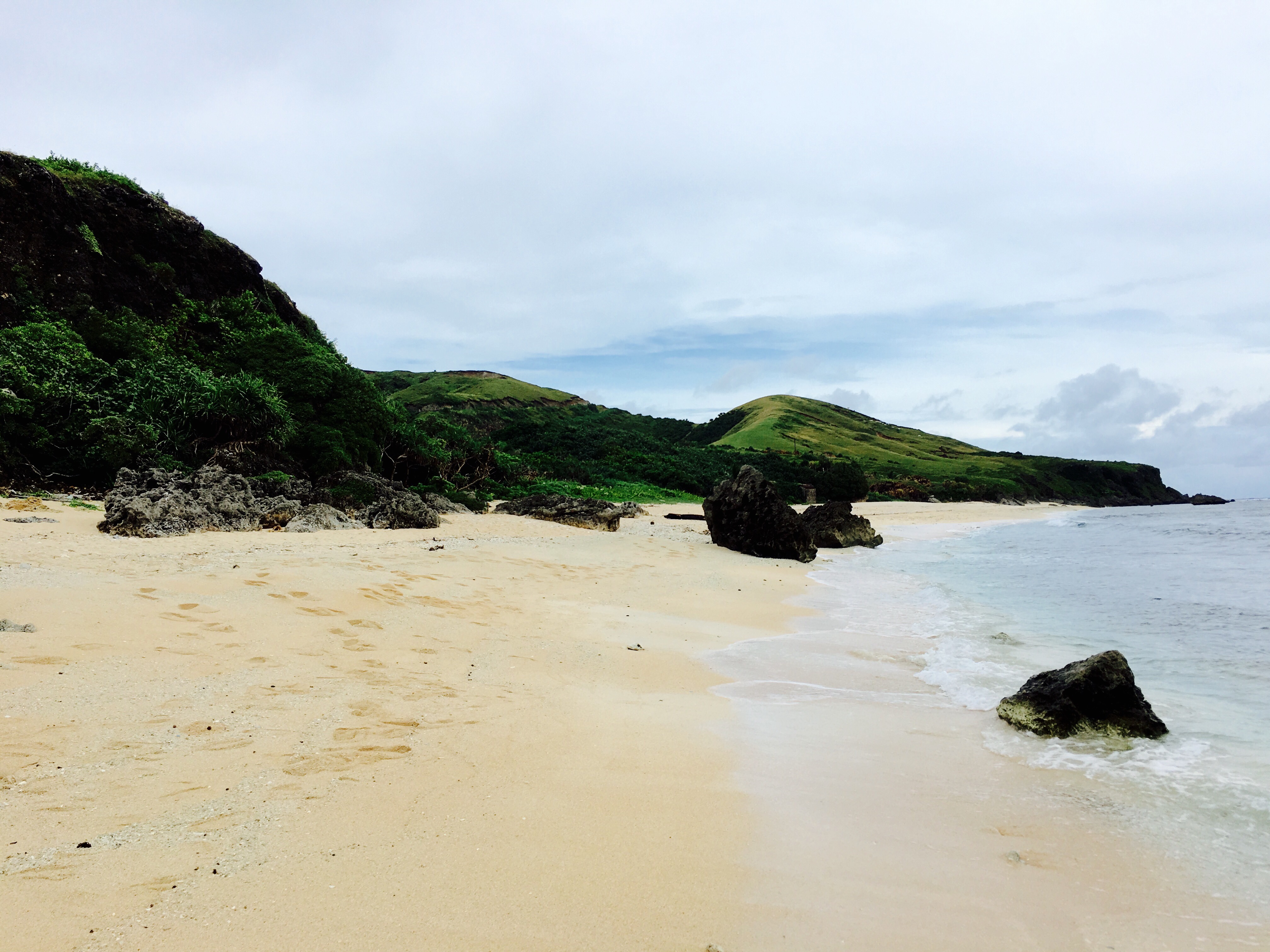
In Sabtang, there’s the very nice Morong Beach which has some really fine white sand. Probably, the best swimming experience you can get in Batanes is from this beach. It is free for everybody to go there. No cottages, no commercial establishments, but there are toilets.
Morong Beach
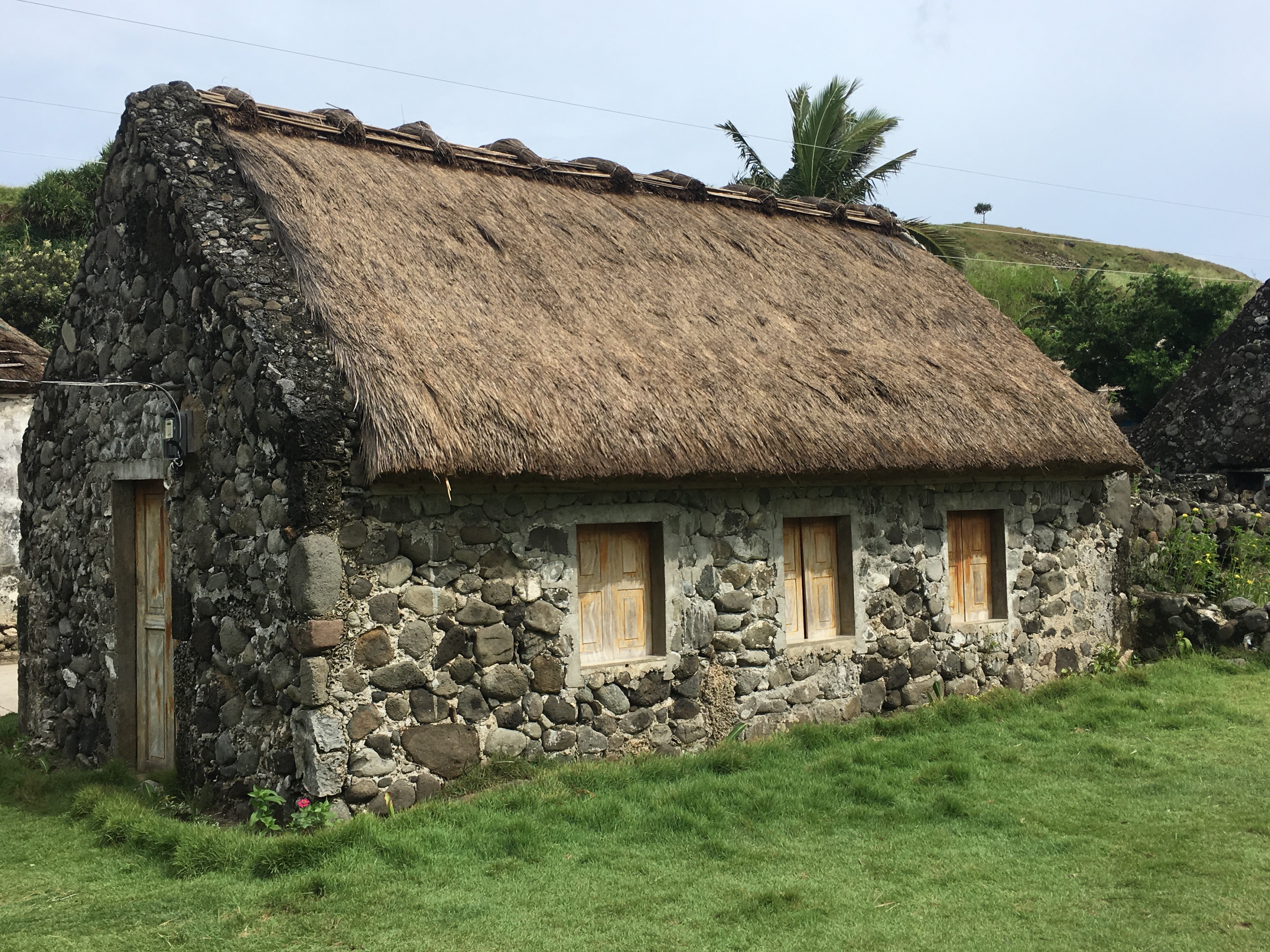
Sabtang has its very distinct character because it is home to the Ivatan stone houses that are very unique to Batanes and have stood there for many years. Those thick brown roofs are made of dried cogon grass.
Ivatan stone house
Ivatan stone house
And then we went to these vast fields of lush greens in Sabtang which stretches out into the sea. You’ll never run out of beautiful landscapes to see in Batanes.
Vast fields in Sabtang
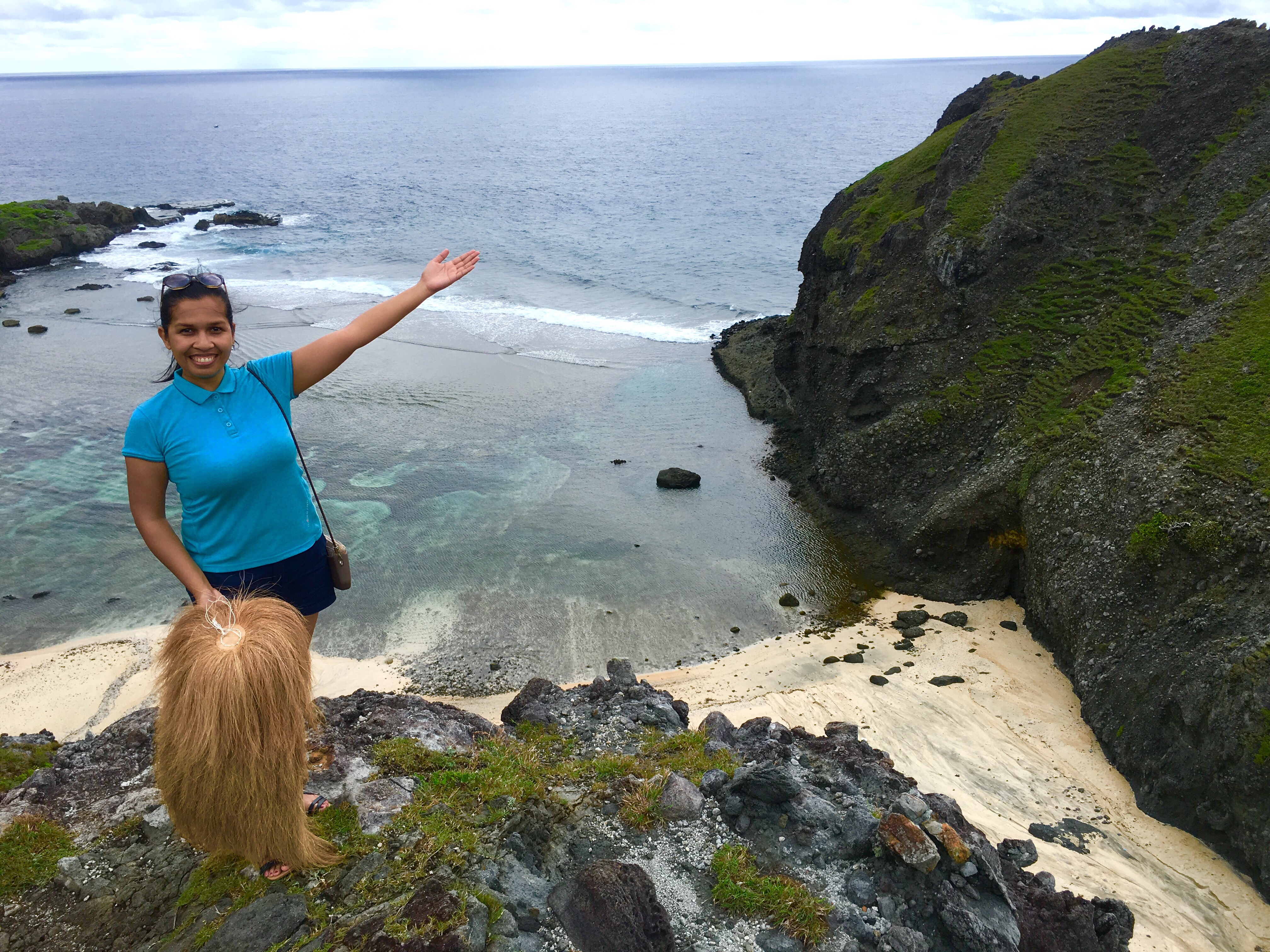
One of the many edges of the lush greens in Sabtang
The Ivatan People
The locals, the Ivatans, are among the nicest people I have ever met. Batanes is home to a very peaceful community and very helpful people. I remember when I and my friends are trying to find a tricycle that will take us to the restaurant for dinner and couldn’t find one, so we asked a random guy in the street where to find them. He said they just call them on the phone and he tried to call one for us. When he couldn’t get an answer, he rode his motorcycle and went to the tricyle terminal and hailed a tricycle for us. That’s one story I will keep telling people about Ivatans.
Fishermen heading to a day out in the ocean
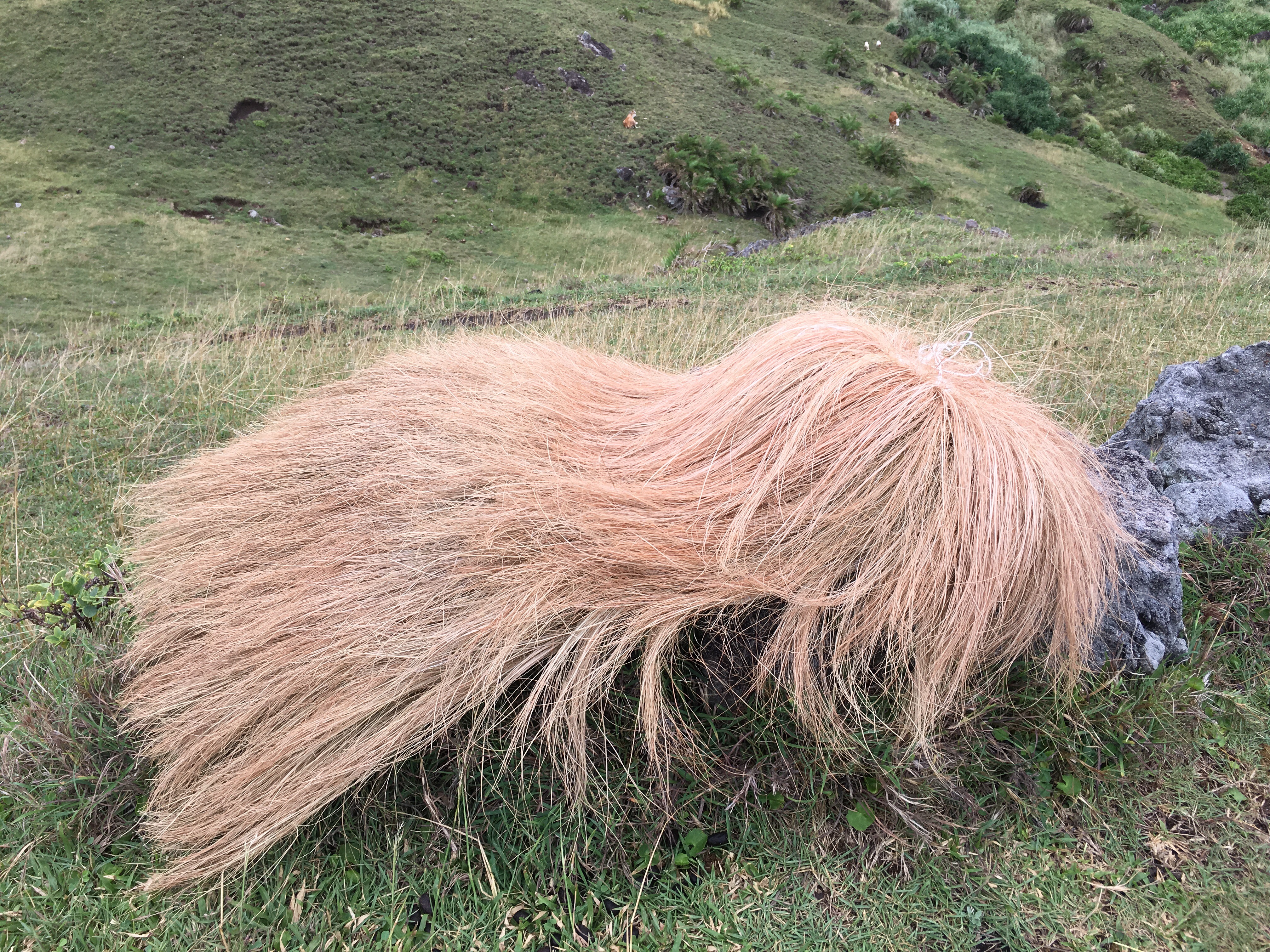
A vakul weaver in Sabtang
Getting food out of the sea
More Interesting Things about Batanes
VAKUL. It is a headdress worn by the Ivatan people for protection from harsh weather elements. It is more commonly found in Sabtang where people weave them from dried cogon grass.
BLOW UR HORN. Yep, those are signs that are only seen in Batanes, so unique that they made them into ref magnet souvenirs. You gotta blow your horn in blind curves. Animals may be crossing the streets.
COCONUT CRAB. This is a local delicacy and served steamed. This crab eats only coconuts and is completely terrestrial. Looks weird, eh? But tastes like our usual freshwater crabs.
SABTANG TRICYCLE. Only here can you see a tricycle with cogon grass roofing and wooden, sculpted body.
HONESTY COFFEE SHOP. The Ivatans are very honest people and they even have a store without any staff in it. They just trust that you pay the right amount in the cash box.
BLANK BOOKS. Somewhere in Batan, we passed by this library of blank books. Everyone is free to write anything on them so you leave a little something of you in Batanes. I am a happy writer in Book #763 😉
VAHAY NI DAKAY. This is the oldest stone house in Batanes, constructed in 1887, which was one of the few which survived a huge earthquake in 1918.
To be able to drive in almost all of the countries that are signatories to the 1949 and 1968 UN Convention on Road Traffic (see list of countries below), you have to be able to obtain the Philippine International Driving Permit (PIDP) and the only issuing body for the PIDP is the Automobile Association of the Philippines (AAP). This details my experience in applying for a new PIDP.
List of countries where the PIDP is valid
So I went to the AAP Tower (2nd floor) in Aurora Blvd (near the Gilmore LRT Station) because I read from the AAP website that when you process it there, you can get it within 1 hour (took me 2 hours though). I think if you apply in Cebu or Davao, you will get it after several days. I brought the following requirements:
Original and photocopy of valid Philippine Driver’s License (Non-Professional and Professional only)
Note that you cannot convert a student driver permit to PIDP
Validity of PIDP is 1 year but if your existing license will expire in less than a year, your PIDP license will also expire along with it
A photocopying service can be found inside the AAP Tower, ground floor
2 pieces 2×2 picture on white background
Php 3,000
For 1-yr AAP membership worth Php 2,000 and processing fee of Php 1,000.
Also includes 1-yr worldwide accident insurance up to Php 300,000 coverage
Major credit cards are also accepted for payment
You will be asked to fill out an application form where you also have the option to register a vehicle in the Philippines. AAP membership offers some perks like free towing etc. Then, the accomplished form (along with the requirements) will be submitted to the encoder, after which, payment will be done, which happens very smoothly.
The waiting time is longest after payment but it took me about 2 hours to complete the whole process. You’ll get all these once done:
Take note that the validity of the PIDP is also 1 year. Renewal may be done via an authorized representative if you are out of the country. Just accomplish the form and submit a photocopy of a valid Philippine license and valid ID of your representative. Also, the PIDP is only valid when it comes with the Philippine driving license, so don’t forget to bring with you abroad your license. For more information, visit the AAP website.
So there, hope this helps! Happy driving wherever! 😀
It has always been my childhood dream to go to Vatican and Rome. So I took a short break from school during Holy Week and planned my solo adventure. I’ve seen posts about Rome and Vatican being too crowded during this time of the year because of the pilgrims and overwhelming amount of tourists but my mind and my heart are really very determined to hear the Easter Mass at St. Peter’s Square so I was not a bit discouraged and happily proceeded. This was my first purely solo trip as I was often with family and friends during vacations so I was also excited to see if I will actually enjoy being with myself.
In Italy, the holidays during the Holy Week are from Good Friday until Easter Monday. I arrived in the afternoon of Good Friday at Rome via the Italian high-speed train Frecciarossa coming from Turin. The trip was about 4 hours. I got an airbnb accommodation (at Via Giorgio Scalia) within walking distance from the Vatican (12 mins to the Vatican Museum, 20 mins to St. Peter’s Square) because I wanted to be able to just walk there and arrive early for the Easter Mass. The place is also very close to the Cipro metro station which makes going to the other tourist destinations in Rome such a breeze.
Walking clockwise to St. Peter’s Square was a nice experience. Walking clockwise from St. Peter’s Square to Via Giorgio Scalia was pretty bad and scary.
GOOD FRIDAY
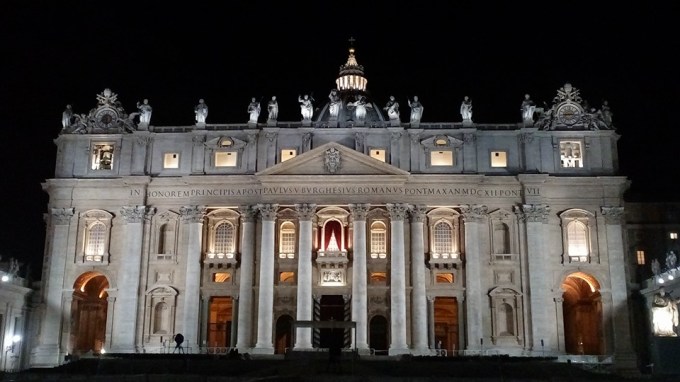
On Good Friday, the Pope leads the Via Crucis (Way of the Cross) at the Colosseo. I initially wanted to go there but did not push through upon the advice of a friend because it starts at 9:15 PM and will end rather late. I went instead to St. Peter’s Square. From my airbnb flat, I walked clockwise to get to St. Peter’s Square, passing by the Vatican Museum. That turned out to be a really good decision because seeing the Vatican at night, for the first time, really touched my heart in a very special way. The mood was so solemn and there weren’t too many people (I assume everyone was at the Colosseo). It was also a good time to pray.
St. Peter’s Cathedral, Vatican City
I decided to complete the clockwise loop going back, for me to see a lot. I saw Trattoria da Angelo alla Cupola not far and decided to take my authentic Roman carbonara from there for dinner. Walking back to my apartment from there was very scary, though. You see, the Vatican is a fortress and there’s a part of Viale Vaticano which isn’t really for walking. I trusted GoogleMaps to get me home and it made me pass a rather deserted street along Viale Vaticano. No one else was walking there and only a few cars passed. It was a residential area but was uphill so it was physically challenging and heart-racing. I did pray really hard as I knew that if I encounter some bad elements in there, my body would never be found. But I made it alive, so I’m thankful! 😀
BLACK SATURDAY
I booked a Vatican Museum, Sistine Chapel and St. Peter’s Basilica half-day tour with Viator to skip the long lines on Black Saturday. It was a peak season for travelers and queues to enter these areas are painstakingly long. Touring with a very good guide who has an Art History degree is really awesome as she made me appreciate and look at all those pieces in ways I couldn’t have had if I went on my own. These people know their history and know what they are talking about which made me really enjoy the tour. Let me run you trough some of my favorites:
Ceiling inside Vatican Museum
Inside Vatican Museum, you could really see very grand things that fit the tastes of the early popes. This one is the most beautiful and the grandest of all ceilings, I guess.
Raphael’s School of Athens, his most famous work, at the Vatican Museum.
The young Raphael has several rooms of paintings here, with the School of Athens being the most famous among them. The fact that he was painting there at the same time that Michelangelo was painting the ceiling of the Sistine Chapel was pretty cool.
Michelangelo’s La Pieta, behind bulletproof glass inside St. Peter’s Basilica.
This is the only piece of art Michelangelo ever signed. He signed it across the chest of the Virgin Mary as he heard rumors saying it was somebody else’s work. He never signed anything after as he was so ashamed of how his pride had made him do that to the religious sculpture.
In this exact location deep down below this altar lies the body of St. Peter.
As a Christian, knowing that you’re this close to St. Peter’s tomb was really so humbling.
In the afternoon, I decided to explore central Rome and see these wonders.
Foro Romano. Ancient marketplace where people hear the latest news and trade stuff, including slaves.
Colosseo
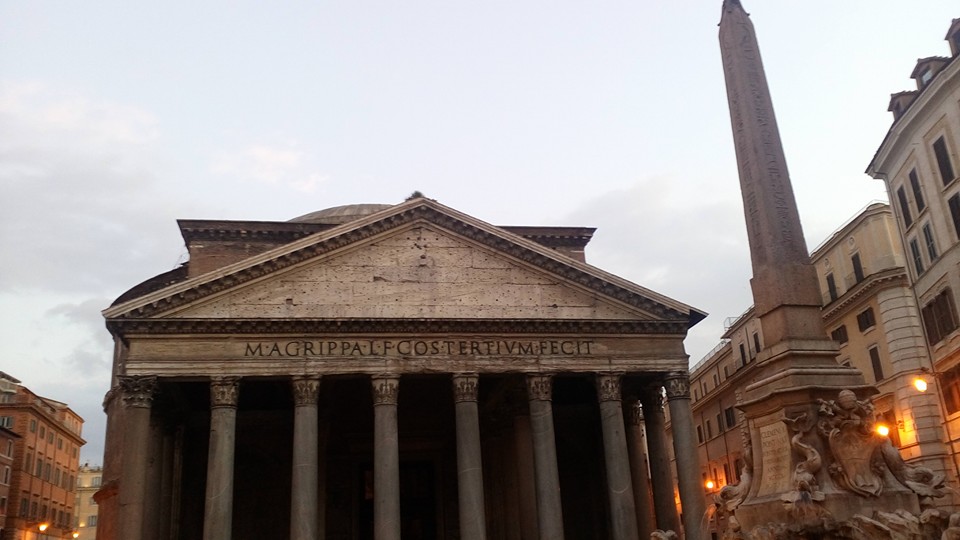
Pantheon. If you read Dan Brown’s Angels and Demons, you’ll know that [Raphael] Santi’s tomb is here and you’ll also know that Robert Langdon was wrong about this first hunch. 🙂
Fontana di Trevi. That fountain in La Dolce Vita 🙂 Threw a coin and made a wish to return!
EASTER SUNDAY
This is the highlight of my trip – to attend the Easter Mass at St. Peter’s Square. If you google how to attend a mass, you’ll know that a ticket (which is free) has to be obtained from the Prefecture of the Papal Household in advance and you have to fax (yes, you read that right, FAX – no option to email) a form requesting for tickets. I did fax them via an internet faxing service but I did not get any response and didn’t get any ticket. But, even if I didn’t have a ticket, I still went to Vatican hoping I could get in because I believe that the Pope is for everyone, with or without tickets 😀 All people queuing had tickets with them. Most of them were part of a huge touring group.
My efforts did pay off. The guards only inspected the bags and didn’t look for tickets. Security was very tight (with Brussels bombing happening a week earlier) but they really weren’t asking for tickets for people to get in. And so I got in! And heard my Easter Mass at Vatican! The experience was surreal! I also met the Marianos, a Filipino family living in Italy and I heard the mass with them. They also did not have tickets and we all were able to go in together. 🙂
I arrived at Vatican at 7:30 AM, was inside St. Peter’s Square at about 9:00 AM for a mass that started around 10:00 AM.
Seeing people from different countries, speaking different languages, coming together for the same faith that binds us all was an experience I’ll never forget.
The best part for me was when I shook hands of people I don’t know, saying “Peace be with you” and getting the same thing said to me in a different language. 😀 And yeah, the Holy Communion at St. Peter’s Square was very special to me. 🙂
Rome has been awesome. I will definitely be coming back. My wish at the Trevi Fountain will not fail me. 😀
















 Happiness.NOW